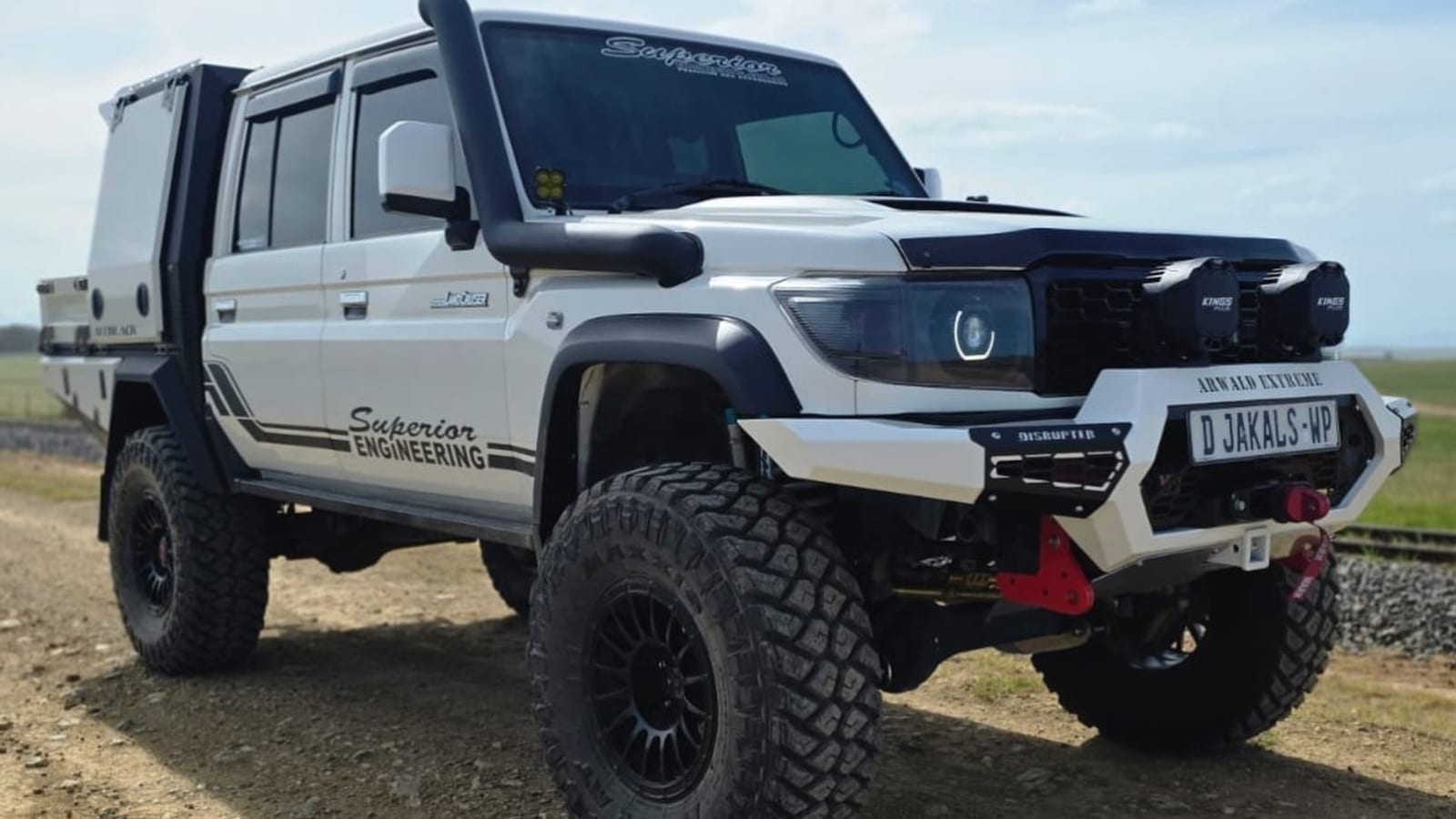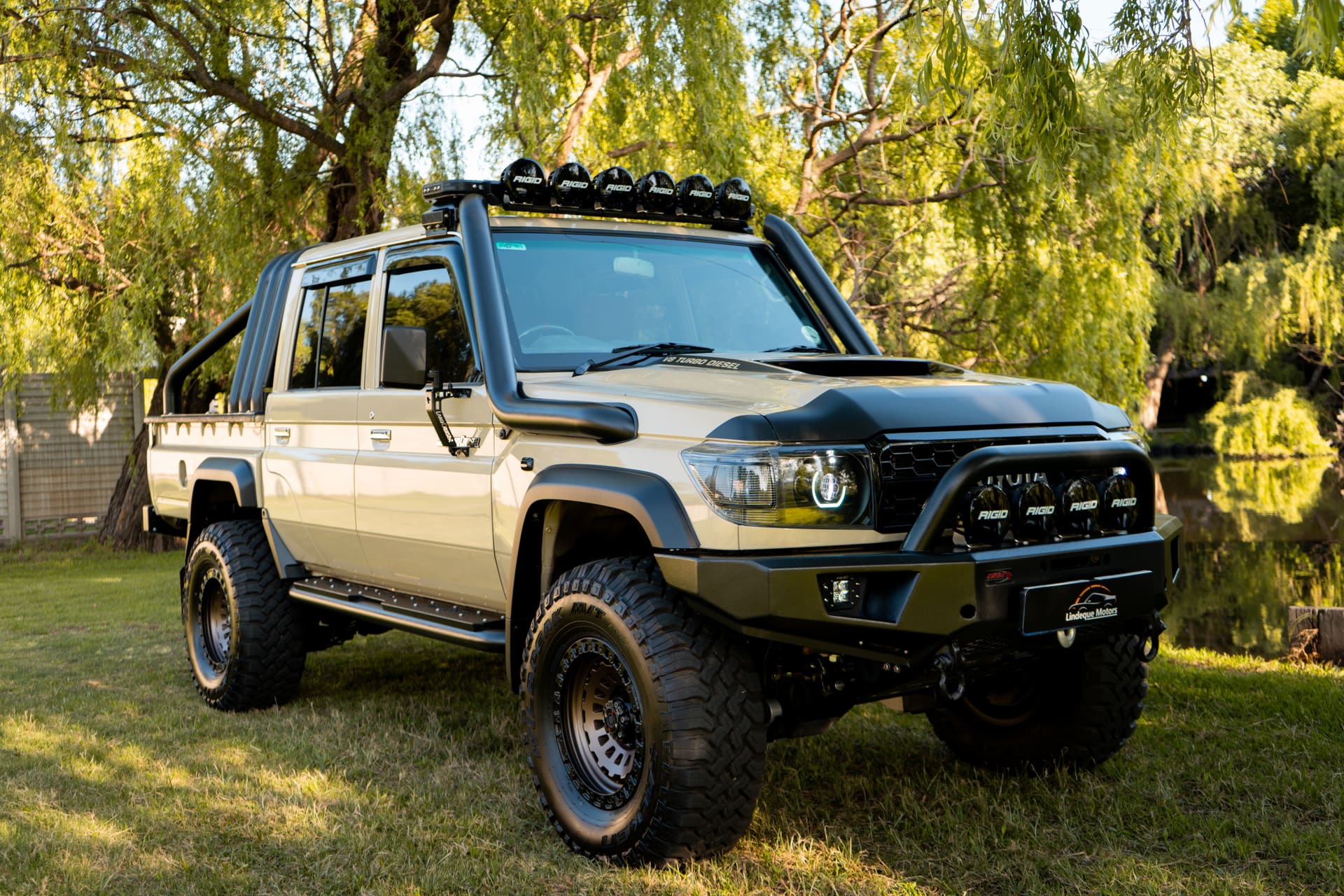
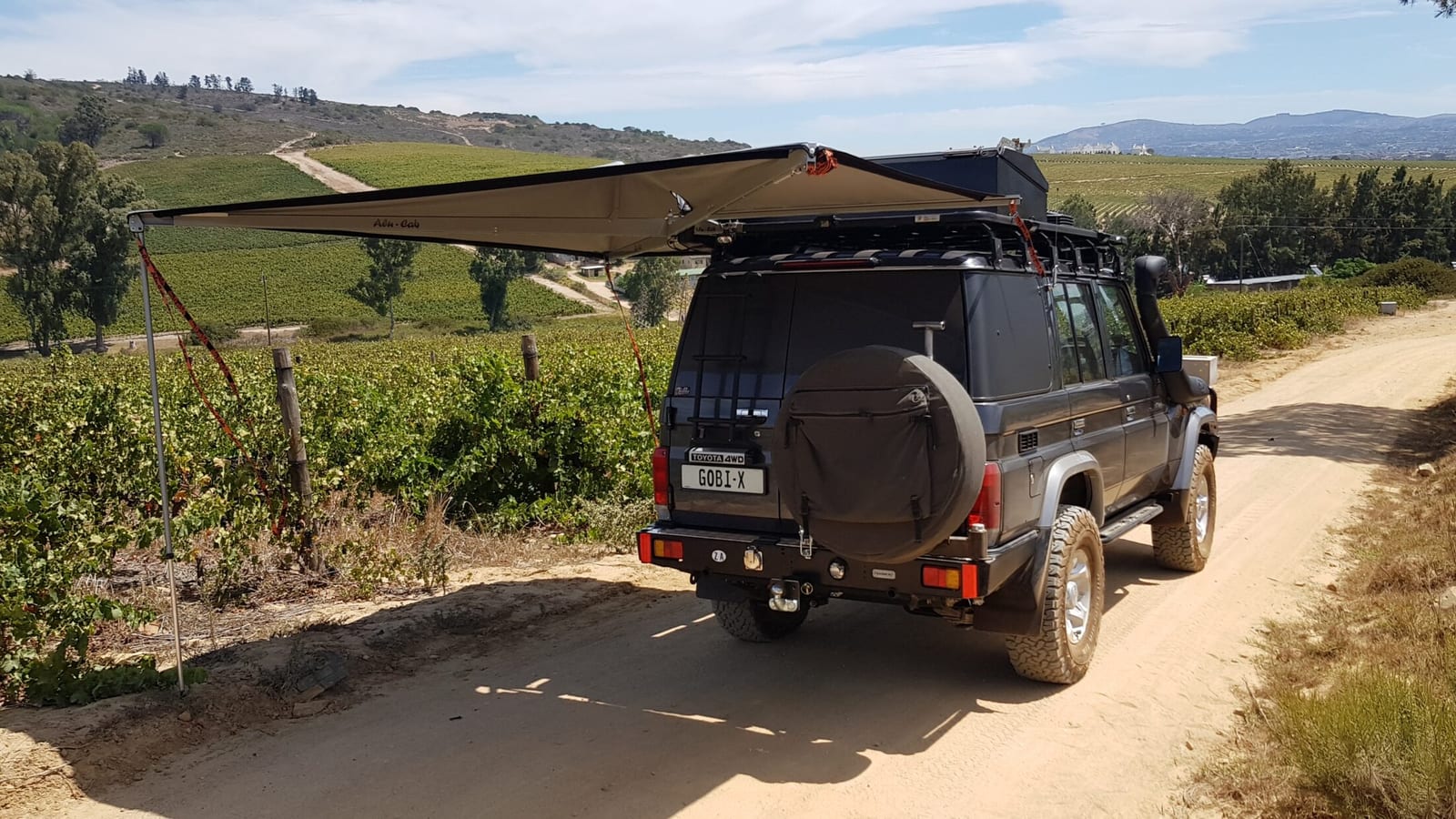
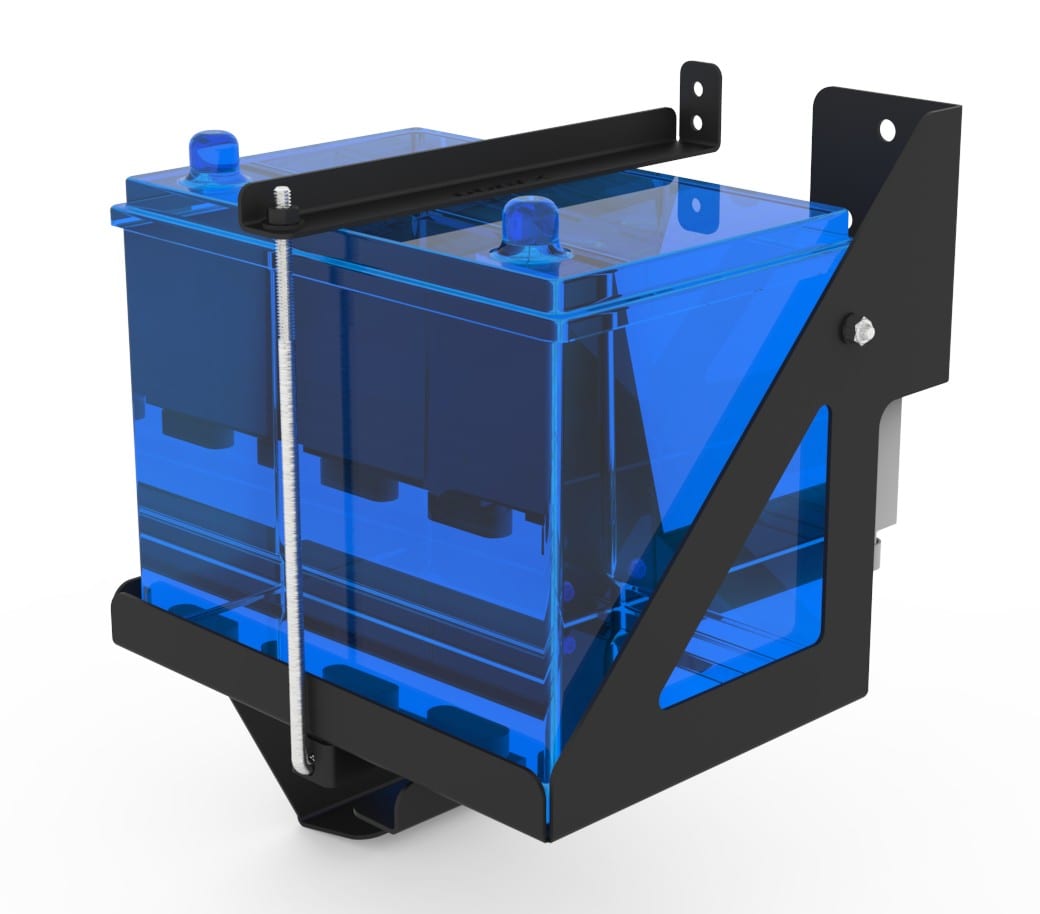
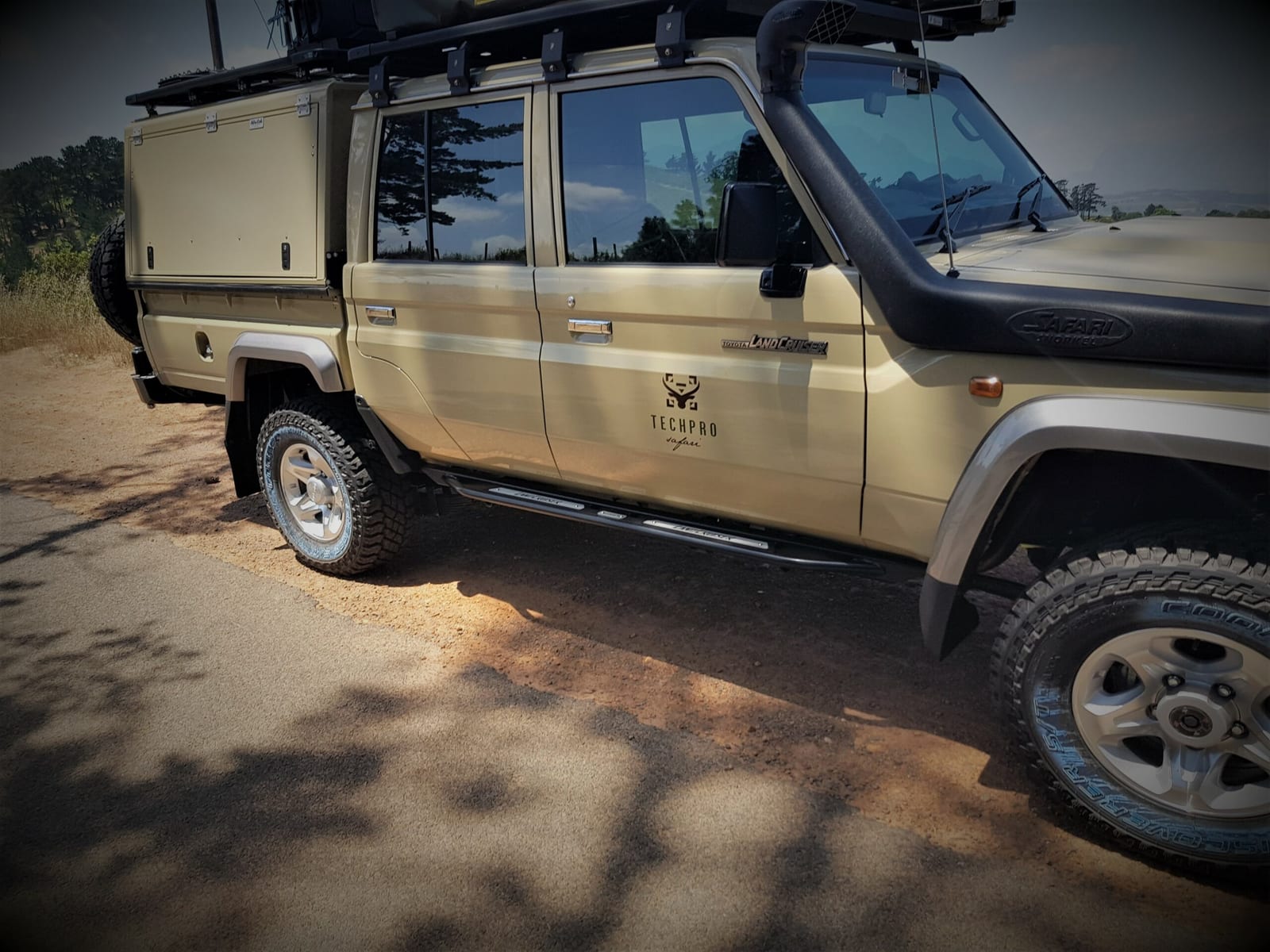
Cover photo: Gobi-X, the Cape Town team who make bumpers, rock sliders and battery brackets for the 70 Series. Go and have a look at their builds.
Most owners buy the fridge first. Then they find out the fridge needs a battery of its own.
That is the job of a second battery. It runs the fridge, the lights and the phone chargers at camp. The battery that starts the car stays full for the morning.
This guide covers what to fit to which Cruiser, where the battery goes and what it costs here. It also covers the big change on the new-shape 79 and 76: the 2.8 engine.
The short answer
- New-shape 79 or 76, from 2024, with the 2.8 four-cylinder: fit a DC-DC charger. In a double cab, a flat lithium battery goes behind the rear seats.
- A 300: the fitted kits we found use a DC-DC charger too.
- Older V8 or 4.2 diesel: a simple relay and a lead-acid battery still do the job.
- One or two weekends a year: a lead-acid battery or a portable power box is enough.
- A week in Botswana without moving much: a big lithium battery and a solar panel.
A fitted DC-DC kit in a 79 double cab costs about R28,000 to R35,000 today. The details are further down.
Why a second battery
The battery under your bonnet is a starter battery. It gives a big burst of power for a few seconds to turn the engine. It does not like being run down slowly all night.
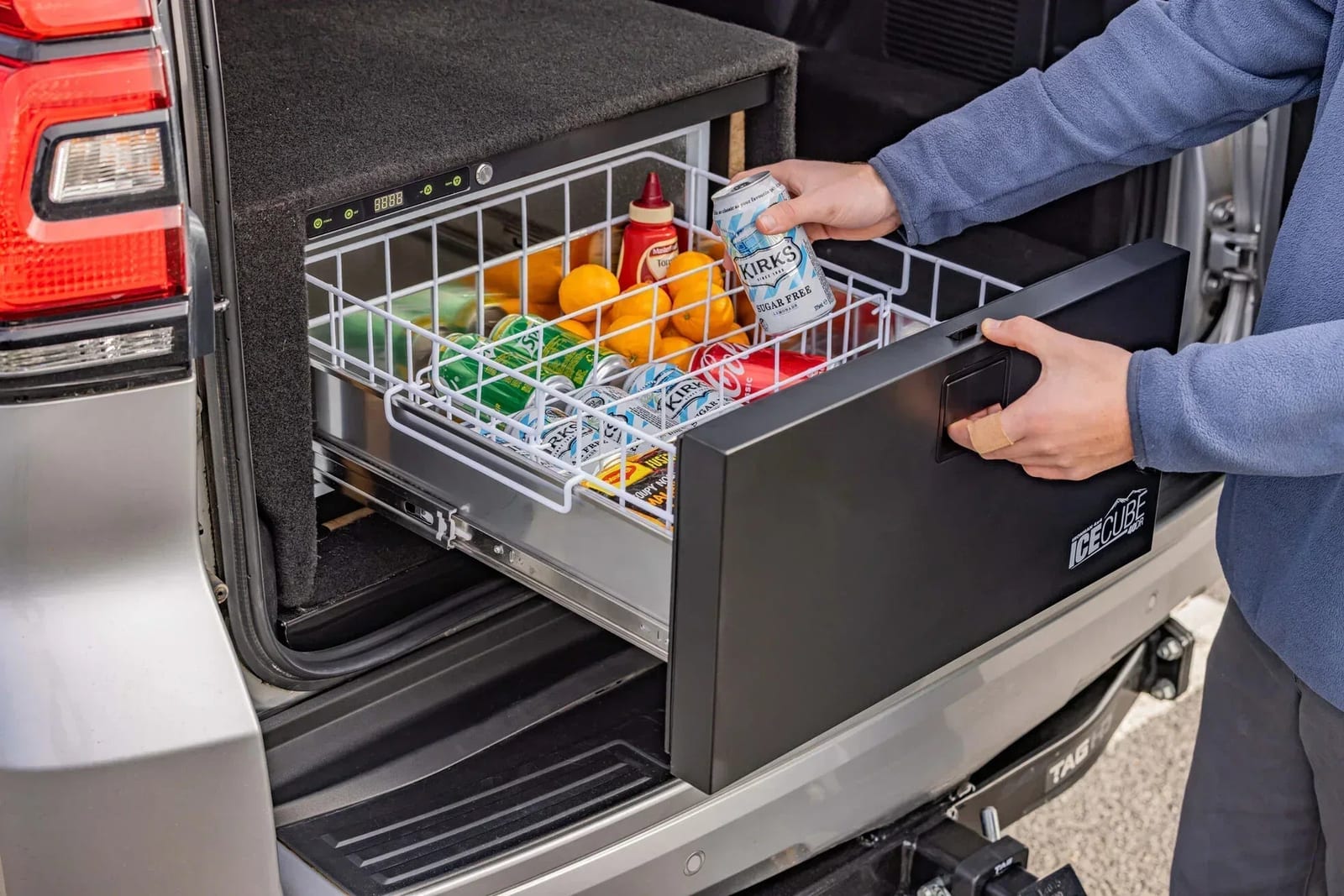
A camping fridge does exactly that. Its motor clicks on and off all day and all night, engine running or not. Run it off the starter battery and you may need a jump start on a cold Kgalagadi morning.
Some fridges switch off before the battery gets too low. That helps for one night. It is not a plan for a week.
So how much power does a fridge use? Battery size is counted in amp-hours, or Ah. A 100Ah battery could give 5 amps for about 20 hours. Fridge makers publish what their fridges use, and heat is the big factor.
| Fridge and conditions | Power used | Source |
|---|---|---|
| National Luna fridge at +4°C | 16 to 20 Ah a day | National Luna |
| Dometic CFX3 45, 32°C outside | about 25 Ah a day (our sum) | Dometic |
| Same fridge at 43°C instead of 21°C | about 3 times as much | National Luna |
| Set to freeze at minus 6°C instead of +4°C | more than 3 times as much | National Luna |
Take a 40 to 50 litre fridge in a South African summer. Plan on it using 20 to 30 Ah a day. Our essential additions guide covers the fridge itself, and every fridge on sale is on our fridges and camping page.
How long will one battery last?
You can’t use all of a battery. A lead-acid battery lives longest if you only use about half. A lithium battery lets you use about 80% of it.
Here is what that means with the fridge on and the car parked. These are our own sums, rounded. Treat them as a guide, not a promise.
| Battery | Usable (about) | Days at 20 Ah a day | Days at 30 Ah a day (hot) |
|---|---|---|---|
| 100Ah lead-acid or AGM | 50 Ah | 2.5 | 1.5 |
| 100Ah lithium | 80 Ah | 4 | 2.5 |
| 200Ah lithium | 160 Ah | 8 | 5 |
AGM is a sealed kind of lead-acid battery. Driving each day tops the battery up, and so does a solar panel. Freezer mode cuts these days short, fast.
Relay or DC-DC charger
The second battery needs charging while you drive. The alternator does that. It is the engine’s own charger, turned by a belt. There are two ways to connect it to the second battery.
A relay is a switch. Fitters also call it a smart solenoid or a split charger. When the engine runs, it joins the two batteries so the alternator charges both. When the engine stops, it splits them. The fridge can then only drain the second battery.
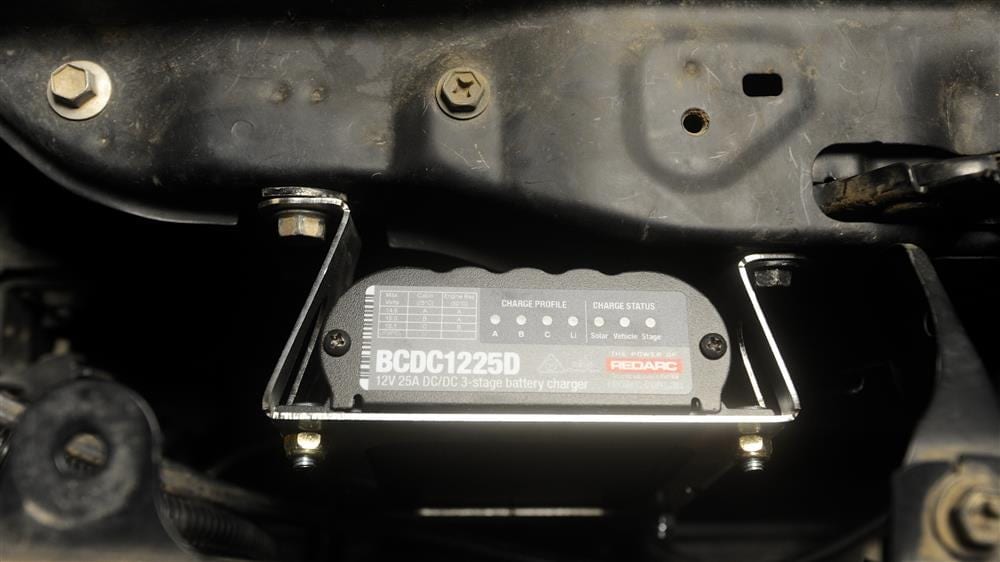
A DC-DC charger is a small box with a proper charger inside. It takes power from the alternator and charges the second battery the right way for its type. Most can take a solar panel as well.
A relay is cheap. The stores we compare list one from about R749. On older engines it works well. In 2017, one V8 79 owner on 4x4community.co.za was told a relay and a separate solar regulator would do. That saved about R2,000 over a DC-DC charger.
The 2.8 is a DC-DC car
The new-shape 79 and 76 use the 2.8 four-cylinder diesel. On this engine, the engine computer controls how the alternator charges. People call this a smart alternator.
An Australian maker of bigger alternators for the 70 Series 2.8 says its unit talks to the engine computer the same way the factory one does. Toyota South Africa’s spec sheets don’t list the alternator at all. So we can’t give you a Toyota figure.
What we can tell you is what South African fitters do. Every fitted kit we found for the 79 2.8 uses a DC-DC charger. The kits for the 300 do too.
A relay only passes on what the alternator gives. When the computer turns the charge down, the second battery gets less. A lithium battery also needs a charger with a lithium setting. On a 2.8, a relay is the wrong tool.
Don’t expect the full rated amps, either. Hilux owners with the same family of 2.8 engine report that a 50 amp charger gives only 30 to 35 amps. The alternator is the limit, not the charger. Size your battery and solar with that in mind.
None of the 13 stores we compare sells a DC-DC charger on its own right now. Fitment centres and solar shops do. In September 2026, a Victron Orion XS 50 amp charger was about R4,705 at SunStore.
Lithium or lead-acid
This is the big argument on the forums. Here is what the same brand costs in each type at one SA store.
| Battery | Price | Weight |
|---|---|---|
| Enertec 110Ah lead-acid | R3,265 | 27.5 kg |
| Enertec Power+ 105Ah lithium | R7,610 | 11.5 kg |
| Enertec 100Ah lithium “blade”, 65 mm thin | R9,418 | 15 kg |
Wolf Customs prices, 24 September 2026. Lithium here means LiFePO4, or lithium iron phosphate, the type used in cars and campers.
The case for lead-acid: it costs less than half as much. It works with a simple relay on older engines. It copes with charging in the cold. Plenty of SA owners say it’s fine if you camp once or twice a year. Just never run it below half.
The case for lithium: it weighs less than half as much for the same size. You can use most of it, and it charges fast. It also holds its charge while the car stands in the garage. The flat blade shape is why it fits behind a double cab’s rear seats. It does need a DC-DC charger with a lithium setting.
How long lithium lasts is still an open fight. One owner reports six years of hot trips with no trouble. Another knows of a battery with a long warranty that died in two. Nobody has the long-term numbers yet.
Heat and cold
Lithium has one rule that matters a lot here. Victron says its lithium batteries should only be charged between 5°C and 50°C.
A hot engine bay is the wrong place for lithium. Victron’s own advice is to check the heat under the bonnet against the battery’s limit. Keep lithium in the cabin or the canopy.
The cold end matters too. On a July night at Sani Pass or in Lesotho, it drops below freezing. Charging lithium when it’s too cold damages it for good. Good chargers stop charging when it’s too cold. Some lithium batteries have a built-in heater for this.
Chargers get hot as well. When they get too hot, they charge more slowly. Owners on 4x4community advise mounting a DC-DC charger with space around it for air.
Live prices · 24 September 2026
Second batteries in stock right now
7 in stock at 2 South African stores today, from R2 623 to R9 999. Typical price about R7 610.
Where the second battery goes
This depends on your model, your cab and your engine.
| Model | Usual spot | Notes |
|---|---|---|
| 79 double cab (2.8 or V8) | Behind the rear seats | A flat lithium battery. Every fitted 79 kit we found puts it here |
| 79 single cab | Load bin, canopy, or under the load body | There is no rear seat |
| 79 V8 or V6 petrol | Engine bay bracket | Gobi-X bracket, R1,250 at Go-4LO |
| 79 4.2 diesel | Engine bay bracket | Gobi-X bracket, R1,550 at Go-4LO |
| 79 2.8 | Cabin or canopy | None of the 13 stores sells a 2.8 engine bay bracket |
| 76 (the station wagon) | Boot, or engine bay on the V8 | Plan it with your drawers |
| 300 | Ask your fitter | We could not confirm the usual spot |
Store prices, 24 September 2026.
An engine bay bracket suits a lead-acid battery on the older engines. It keeps the cable short and the cabin clear. Remember the heat rule if you want lithium there.
In a 76, drawers can leave no space for a big battery underneath. Plan the battery and the drawers together. Our 79 vs 76 guide covers the other differences between the two.
On a single cab, a canopy is the natural home for the battery, next to the fridge it runs. Our canopies and trays guide covers the canopy itself.
Two more rules apply wherever it goes. First, bolt it down. The road rules say a load must be secured, and a loose battery is a heavy object in a crash. Second, if you run two second batteries, make them the same make and size. Owners warn that mismatched batteries drain each other.
What it costs, fitted
Store prices are for parts. A fitted kit adds the charger, thick cables, fuses and most of a day in the workshop.
Here is one Johannesburg fitment centre’s price list. These are G4 Outdoor’s prices on 24 September 2026. It is one shop, so get two or three quotes.
| Car | Kit | Battery | Fitted price |
|---|---|---|---|
| 79 2.8 double cab | National Luna 25 amp DC-DC | 105Ah lithium, behind the rear seats | R28,450 |
| 79 2.8 or V8 double cab | Victron 50 amp DC-DC, solar charger, mains charger | 100Ah lithium, behind the rear seats | R28,800 |
| 79 2.8 or V8 double cab | Victron 50 amp DC-DC | 200Ah lithium, behind the rear seats | R35,000 |
| 76 V8 | Victron system (details not listed) | Not listed | R28,000 |
| 300 | Victron 50 amp DC-DC | 90Ah deep cycle | R27,000 |
| 300 | National Luna 25 amp DC-DC with monitor | 90Ah deep cycle | R29,900 |
Other names that come up: one 76 owner had his battery fitted at Bailies 4x4, and WR Off Road in Pretoria does dual battery work. 4x4 Mega World is Redarc’s official distributor in South Africa.
Want to lift the whole lot out when you’re not camping? A battery box with the charger built in is the other route. You add the battery.
Live prices · 24 September 2026
Battery boxes with a DC-DC charger built in
3 in stock at 3 South African stores today, from R8 599 to R11 999. Typical price about R8 599.
Solar and inverters
Solar keeps the battery topped up when you stop for more than a night or two. A fold-out panel or a solar blanket is the usual choice. Most DC-DC chargers take a panel directly. Park the car in the shade and put the panel in the sun.
Live prices · 24 September 2026
Solar panels and blankets in stock right now
10 in stock at 5 South African stores today, from R2 799 to R8 950. Typical price about R6 300.
An inverter turns 12V into 230V, like a wall plug at home. Only buy one if you have something that truly needs 230V. Every change from 12V to 230V wastes power. Most camp kit charges from USB or 12V anyway.
The full range of batteries, boxes, isolators and panels is on our dual battery and 12V page.
Weight and payload
A battery system eats into what your Cruiser can legally carry. The car’s maximum loaded weight is called the GVM. Take away what the car weighs empty, and you get the payload.
| Model | Payload (our sum from Toyota SA figures) |
|---|---|
| 79 2.8 single cab | 775 to 1,175 kg |
| 79 2.8 double cab | 810 to 1,050 kg |
| 76 2.8 | 575 to 795 kg |
| 300 diesel | 575 to 755 kg |
The range covers the different versions of each model. Lithium saves about 16 kg over the lead-acid battery in the table above. That matters most in the 76 and the 300, which have the least to spare. Our GVM upgrade guide covers what to do when you run out. If you are also adding a long-range fuel tank, count that weight too.
Warranty and insurance
New Cruisers carry Toyota’s warranty of 3 years or 100,000 km.
The Competition Commission’s aftermarket guidelines apply here. They came into force in July 2021. In plain words:
- You may have parts fitted by a fitter of your choice during the warranty.
- If that fitter’s work causes a fault, Toyota can refuse that one claim. The rest of the warranty stands.
- The fitter must warn you about that risk in clear terms.
- An independent fitter must record the work in your service book.
The guidelines set out how the Commission sees things. They are not a law on their own.
A dual battery taps into the car’s charging system. So a wiring fault is the real risk. Use a fitter who writes the work in your service book and gives you an itemised invoice.
For insurance, tell your insurer about the kit and keep the invoice. That way it is on record if you ever claim.
Do you need one at all?
Not everyone does.
A portable power station is a sealed lithium box with its own charger and plugs. There’s nothing to fit, and it can run the lights at home when the power goes off. One example is the EcoFlow River 2 Pro, a refurbished unit at R7,895 at Opposite Lock. By our sums it holds about as much as a 60Ah 12V battery. Charging it from the car’s 12V socket is slow.
If you drive every day and camp one night at a time, a fridge with its own low-battery cut-off may be enough. On a cold morning that is still a risk.
And don’t fit one for resale. Only about 1 in 50 used 79s on our live listings even mentions a second battery. Buy it for your trips.
Who should fit what
| You | Fit | About |
|---|---|---|
| One or two weekends a year | Portable power station | R3,695 to R9,995 |
| Older V8 or 4.2, weekends | Relay, lead-acid battery, engine bay bracket | Parts from about R4,600, plus fitting |
| New-shape 2.8 79 double cab | DC-DC charger and flat lithium behind the rear seats | R28,450 to R35,000 fitted |
| 79 single cab | Battery box with a DC-DC charger, in the canopy or load bin | R8,599 to R11,999, plus the battery |
| 300 | DC-DC kit | R27,000 to R29,900 fitted |
| A week parked in Botswana | 200Ah lithium, 50 amp DC-DC, solar | About R35,000 fitted (79), plus a panel |
Store and fitment centre prices, 24 September 2026. Power stations from Opposite Lock. The older V8 parts are a R749 relay, a R1,250 bracket and a R2,623 battery.
Planning the rest of the build? Our 2024 facelift fitment guide covers which parts fit the new-shape 79, and the 79 accessories page has today’s prices.
The bottom line
A second battery is what makes a fridge work off-grid. On the new 2.8 cars, fit a DC-DC charger. In a double cab, a flat lithium battery behind the seats is the neat answer. On an older V8 or 4.2, a relay and a lead-acid battery still work fine. Keep lithium out of the heat, bolt everything down and get more than one quote. And if you only camp twice a year, a portable power station may be all you need.
Thinking of changing Cruisers instead? Every Land Cruiser for sale in South Africa is on our listings page.
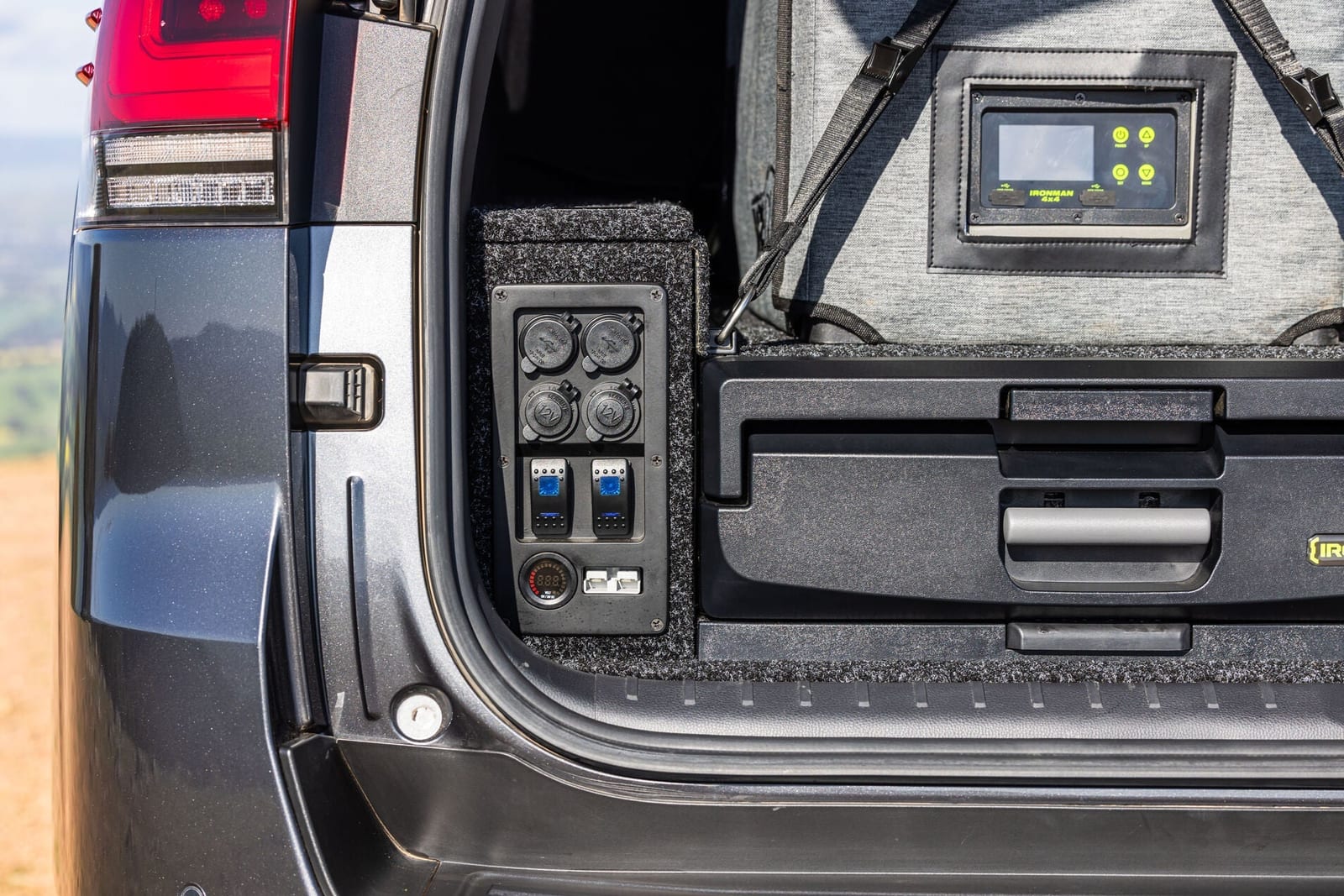
A big thank you to the people whose photos made this guide: Gobi-X, Ironman 4x4 Africa and REDARC. Go and see their work, and support the local fitters who keep South Africa’s Cruisers powered up in the bush.